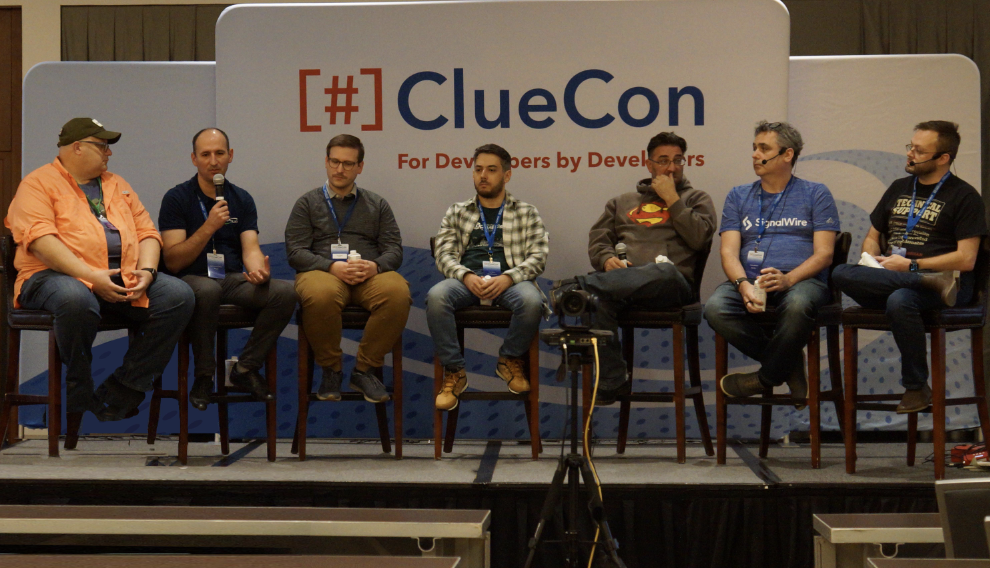



Stay tuned for more information about ClueCon 2012! |
![]() Try, Buy or Resell CudaTel from Barracuda Networks. The only PBX designed for FreeSWITCH by the actual creators of FreeSWITCH! |
Welcome To FreeSWITCH
The World's First Cross-Platform Scalable FREE Multi-Protocol Soft Switch
FreeSWITCH is a scalable open source cross-platform telephony platform designed to route and interconnect popular communication protocols using audio, video, text or any other form of media. It was created in 2006 to fill the void left by proprietary commercial solutions. FreeSWITCH also provides a stable telephony platform on which many telephony applications can be developed using a wide range of free tools. More
Nice Blog Post at 2600hz: Difference Between OpenSIPS and FreeSWITCH
The guys over at 2600hz use a lot of open source software in their projects. Two key components in their telephony stack are FreeSWITCH and OpenSIPS. This blog post does a nice job of breaking down the roles these components play. If you or someone you know is having trouble grasping the difference between a proxy (OpenSIPS) and a B2BUA (FreeSWITCH) then definitely read the 2600hz blog - it wlll really help them visualize the difference by using simple analogies.
-Michael
Licensing Content In Buffers?! Yeah, Someone Actually Wants To Do That
Wow. Just... wow. From copyright hawk Cory Doctorow comes this report about the "Trans Pacific Partnership" trying to force people to have a content license for content that resides in buffers. Yeah, my jaw dropped, too. Anyway, keep your eyes and ears open. Hopefully this won't go anywhere.
-Michael
WebRTC Gets a Shot in the Arm with mod_iSAC!
Many of you have heard some rumblings about WebRTC, something that will hopefully make browser-based telecommunications a viable option. One key facet of WebRTC is the iSAC voice codec. We are pleased to announce that Anthony Minessale has just committed mod_iSAC, a FreeSWITCH module that enables the iSAC codec.
The new module supports iSAC at 16kHz sampling rate with 30ms and 60ms ptimes as well as 32kHz at 30ms. This module is so new that I haven't even had a chance to try it out, although I did download, compile, and load it on my FreeSWITCH box - and I didn't even have to shutdown and restart.
We would like to encourage our intrepid Web developers to give the WebRTC toolkit a test drive. We would like to see some interesting new Web-based applications powered by FreeSWITCH. Thanks again for supporting Free and Open Source Software!
-Michael
Math Geeks Rejoice: Faster FFT Algorithm Discovered
I thought this would be of interest to the more cerebral of our readers. From Slashdot, we have word that some bright folks at MIT have discovered an improved FFT algorithm that, in many cases, is more efficient than the venerable FFT that we've been using for so long. The details can be found in this story from MIT's news site.
Hopefully this new discovery will lead to improvements in digital signal processing that will benefit us all.
-Michael
Create Twilio-like Applications With The Hypertext Telephony API!
The FreeSWITCH team is proud to announce a new module for creating Web-based telephony applications: mod_httapi - the Hypertext Telephony API. This new module allows the FreeSWITCH dialplan to make an HTTP request and receive call processing instructions from a Web server. The Web server returns an XML document that contains "HT TAPI" markup which tells FreeSWITCH how to process the call.
If you are familiar with FreeSWITCH's XML CURL interface (mod_xml_curl) then you may be wondering why we need HT TAPI when XML CURL allows for complete control of FreeSWITCH configuration and dialplans. The answer is: simplicity. The HT TAPI markup allows you to create call flows and IVRs without needing to know the intricacies of the FreeSWITCH XML dialplan. HT TAPI is an abstraction layer that makes it easier to create simple call flows but still exposes the full power of the FreeSWITCH XML dialplan. The result is a framework that allows for building telephony applications in much the same way that Twilio does.
How does mod_httapi work? It provides an API and a dialplan application, both of which are "httapi". The API lets you turn console debugging on and off so that you can see the XML document returned by the server, or any errors. The dialplan application is what triggers the HTTP request to your Web server. Here is a sample dialplan extension:
<extension name="HT TAPI example">
<condition field="destination_number" expression="^1234$">
<action application="httapi" data="{url=http://myserver.com/myscript.cgi}"/>
</condition>
</extension>
When the FreeSWITCH dialplan executes this application, the call is made to the target server which runs a CGI script. (On the server you can use CGI, FCGI, or whatever you like to return the XML document that contains the HT TAPI markup.) The server will return a document like this:
<document type="xml/freeswitch-httapi">
<work>
<pause milliseconds="1500"/>
<playback file="http://myserver.com/sounds/ivr-welcome_to_freeswitch.wav"/>
</work>
</document>
This simple document will answer the call, wait 1500 milliseconds, and play a sound file. There are many call control options, including capturing DTMFs, recording calls, conference, voicemail, dialing out, sending SMS messages, and others. Complete documentation on the HT TAPI syntax can be found in the file mod_httapi_doc.txt as well as the wiki page. The mod_httapi source tree also has a set of examples for Perl and PHP scripts to run on the Web server.
In addition, mod_httapi supplies a new file format that allows you to serve up WAV files from the Web server. In fact, you can use this syntax in standard XML dialplans even if you don't use the httapi dialplan application. This allows for distributed configurations and HTTP caching for WAV audio files.
We invite everyone to try out this new module. As usual, thanks to Anthony Minessale for constantly adding new things to FreeSWITCH.
-Michael
Gemeinschaft 4.0 - Based on FreeSWITCH - Officially Released
Stefan Wintermeyer from Amooma made the announcement that the latest version of Gemeinschaft, version 4, would use FreeSWITCH instead of Asterisk. I am pleased to relay the news that Gemeinschaft 4.0 was officially released yesterday. (Announcement in German is here.) Following is an unofficial English translation of the release announcement:
Five years ago the first version of Gemeinschaft was brought to life. I'm proud to present version 4.0 of Gemeinschaft today (http://www.amooma.de/gemeinschaft).
On this occasion I would like to thank to the Federal Office of IT Security (BSI) for the development contract for Gemeinschaft 4.0 within the SiVoIP project. In addition special thanks to Sascha Daniels, Philipp Kempgen, Peter Kozak, Klaus Knopper and Ralf Spenneberg.
Gemeinschaft 4.0 is a huge step towards a secure VoIP PBX for everyone.
Main differences From Gemeinschaft 3.x
=========================
- Asterisk was replaced by FreeSWITCH and Kamailio
- PHP was replaced in favor of Ruby on Rails 3
- Test-driven development
- Easy install with bootable ISO
- Security, stability and performance
- All data can be saved encrypted on disk (including fax and voicemails)FAQ
===
Q: I'm happy with Gemeinschaft 3.x. Should I upgrade?
A: No, never change a running system! But read https://www.heise.de/artikel-archiv/ix/2011/11/131 and decideQ: How many lines of the Gemeinschaft 3.1 code were recycled in Gemeinschaft 4.0?
A: 0 linesQ: Why no more Asterisk?
A: FreeSWITCH is better, more stable, more secure and gives higher performance. In the past all people used sendmail and now postfix is the best choice. That's the way it is.Q: Why no more PHP?
A: Ruby on Rails is much better http://www.ruby-auf-schienen.deQ: More FAQ's?
A: Yes, have a look at https://github.com/amooma/GS4/wiki/FAQ
Congratulations to Stefan and all the guys at Amooma for all of their hard work. We look forward to seeing how Gemeinschaft continues to grow and evolve in future revisions.
-Michael
VoIP News Picks
Hello all! A few interesting articles have come by my desk and I thought I'd share them with you.
- HD Voice in America - Through the Back Door in 2012?
- VoIP Mobile Subscribers to Triple to 29 Million Users
- VoIP Solutions Dramatically Increased Last Year
- Overcoming VoIP Adoption Hurdles
- Star2Billing Offers Open Source Voice Broadcasting Platform (Based on FreeSWITCH!)
On a humorous note, check out this post about President Obama having his own VoIP glitch. I particularly enjoyed the "Max Headroom" reference.
-Michael
vBilling, The First Open Source Billing Platform For FreeSWITCH, Goes Beta
There has been a lot of interest among the community about open source billing alternatives for FreeSWITCH. We are happy to relate the news from Muhammad Naseer (IRC: Goni) that his vBilling project has officially entered beta status! From the vBilling website:
vBilling is the the first open source billing platform for FreeSWITCH. With vBilling you can start your own calling card services, send SMS, conference call and voice mail and much more. You can even manager your existing wholesale or retail VoIP business. Because it’s all Open Source, vBilling will always be free and fast evolving. We have developed vBilling using simple architecture that is very easy to configure, so with just a few steps you can create and deploy a very strong billing plateform utilizing the power of FreeSWITCH. You can also deploy wide range of telephony applications and services, including IP PBXs, VoIP gateways, call center, IVR systems and much much more.
We invite those in the FreeSWITCH community to try out vBilling and give Muhammad some feedback so that he can improve the product that he has graciously given to the world. There are instructions and install scripts available here. Give it a try!
-Michael
New FreeSWITCH Book For The New Year!
Just a note, in case you hadn't heard: the FreeSWITCH Cookbook has officially been announced by Packt Publishing! Anthony, Darren, Raymond, and I have worked diligently to get these recipes ready for publication. We will definitely keep everyone informed as to the availability of the Cookbook. Also, stay tuned for information on some FREE bonus content!
-Michael
FreeSWITCH Training: Austin (Update)
Good news from the training front: 2600Hz has just informed me that the training for Austin, TX has been set for February 27-29, 2012. This is a 3-day bootcamp session. Visit the VoIPKB site for registration and accomodation information.
-Michael


Recent comments
2 years 14 weeks ago
2 years 31 weeks ago
2 years 35 weeks ago
2 years 36 weeks ago
3 years 5 weeks ago